
What is a load bank used for?
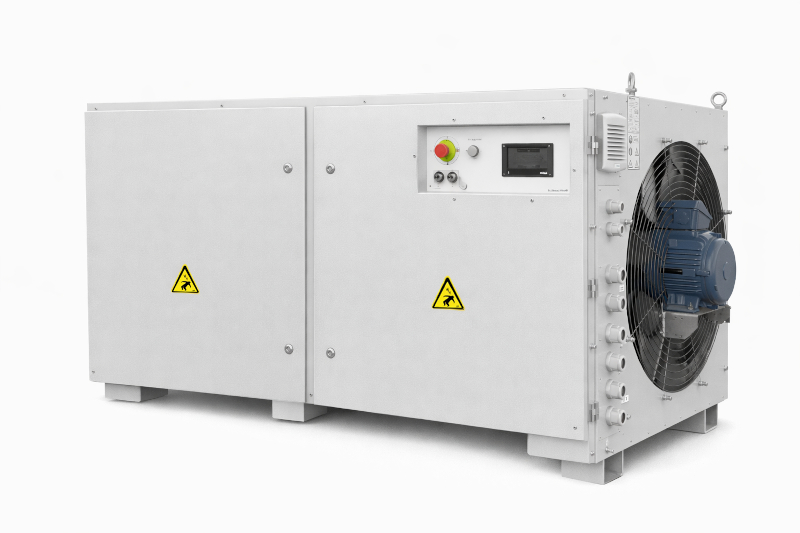
Issues
Why use a load bank?
For reasons of safety, maintenance, compliance, or risk mitigation, it is essential to test your power supplies or those of your customers. This ensures the long-term safe operation of your equipment (generators, inverters, batteries, motors, turbines, etc.) and reduces the number of equipment failures. The solution is to use load banks tailored to your needs (ranging from 50 kVA to 3,300 kVA).
Thanks to the different types of loads—resistive, capacitive, or inductive—you can accurately replicate the operating conditions of your electrical equipment. As a result, it will perform better and may even provide you with a return on investment (generator).
Principle
How does a load bank work?
Generators rarely operate at full capacity for long periods of time.
It is when the engine is running under light load that risks such as fouling, moisture buildup, and carbon buildup can occur, particularly in the combustion chambers and the exhaust system. The solution is to push the system to its full capacity using a load bank to determine its maximum power output over a given period.
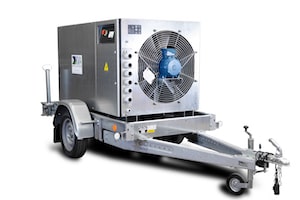
Trailer-mounted load bank
The use of load banks thus enables preventive maintenance and improves the performance of your systems.
Key Features
The 3 Main Functions of a Load Bank
Test your equipment under full load
This is to ensure the performance of the manufacturer’s electrical equipment (resistive and inductive load bank + alternator), to test the endurance of an inverter (resistive and capacitive load bank + inverter), to verify the proper operation of a backup power source that is rarely used at full power without interrupting or disrupting the facility’s power grid (resistive load bank + emergency generator), or to simulate equipment on an isolated grid (resistive load bank + microgrid).
Keep your equipment in good working order and performing at the manufacturer’s specifications by running your generator for several hours
Objective: To extend the service life of a rental generator used at low load for long periods, since at low load the engine does not reach its optimal operating temperature and becomes clogged with deposits (resistive load bank + generator), to test the endurance of a rarely used inverter whose battery has lost some of its capacity (resistive and capacitive load bank + inverter).
Lester to Prevent Failures
The goal is to maintain a minimum power output of 30% to 50% of the rated power on your generator set (resistive load bank + generator set), compensate for excess reactive power in your system caused by lighting (capacitive load bank + IGH) or the reactive power from long cable runs (inductive load bank + generator set).
Benefits
The Load Bank: A Reliable Return on Investment for Your Generators
Load banks allow you to:
– Reduce the risk of breakdowns and costly repairs
– Extend the service life of your equipment, thereby improving profitability
– Reduce fuel consumption and limit pollutant emissions
– Prevent forced downtime of your generator sets
– Meet regulatory requirements for emergency generator sets regarding fire and panic risks (Article EL18: Public Access Buildings – Decree of June 25, 1980, and Article GH43: High-Rise Buildings – Decree of December 30, 2011)*
This highlights the importance of test benches in sectors where power supply is critical, such as medical centers and hospitals, public access buildings, emergency services, as well as large-scale production facilities and data centers (computer rooms, telecom groups, data storage, etc.).
*Legal Reminder: “Emergency generators must undergo regular maintenance and testing at the following minimum intervals: monthly automatic start-up tests with a minimum load of 50% of the generator set’s power, and operation at that load for a minimum of 30 minutes.”
Our Expertise
Delta Resistel is here to support you and meet your needs
With a range of modular products and a wide variety of designs (resistive, inductive, capacitive, rack-mountable, tunnel-type, discharge benches, containers, etc.), Delta Résistel is able to meet your needs and live up to your expectations, ensuring your safety and peace of mind.
As proof, leading companies facing complex challenges already trust us: Kiloutou, Loxam, Gay Électricité, BES, Eneria (Caterpillar), EDF, the French Army, …
Do you have any questions? Need a quote for a load bank project? Contact us!